The Long Pause
In January 2025 a drill on the East Antarctic plateau reached bedrock at 2,800 metres and recovered ice formed more than a million years ago. It had not sat still: it had compacted, recrystallised and moved slowly with the ice sheet. What it had not done was return to the fast water cycle.
The slowest reservoir
Every reservoir in the water cycle has a characteristic time. A molecule spends about nine days in the atmosphere, weeks in a river, years to centuries in a lake, and can spend a very long time indeed underground. Ice is the extreme case. In the interior of Antarctica, where snow falls a few centimetres a year and nothing melts, water can remain frozen for hundreds of thousands of years while moving only slowly through the ice sheet, without returning to the atmosphere, the rivers or the ocean.
It is easy to read that as water being taken out of the cycle. It is not. The ice sheet is the cycle running at its slowest setting: precipitation in, flow through, discharge at the coast. What changes is the clock, not the process.
And because the ice stays isolated from rapid exchange, much of what arrived with the snow is preserved with it — dust, sea salt, volcanic material and, later, air sealed into the closing pores of the firn. That is why an ice-core drill is not only a geological instrument. It is also a sampling device pointed at an atmosphere that no longer exists.
How snow becomes an archive
The mechanism is unglamorous. Snow lands and is buried. Under its own accumulating weight it compacts into firn, a porous halfway state that is still connected to the atmosphere above. Somewhere in the first hundred metres or so those connections pinch shut, and the air stops being the sky and becomes a sample.
This has a consequence that matters for reading the record. The air trapped at any depth is younger than the ice around it, because it kept exchanging with the surface while the ice was already buried. On the low-accumulation plateau of East Antarctica, that offset runs to thousands of years, and it has to be modelled rather than assumed.
Deeper down, a second distortion sets in. The weight above thins each annual layer, and the ice spreads outward as it is compressed. Layers that arrived tens of centimetres thick end up as millimetres. This is what makes very old ice both possible and difficult: a million years can be stored in the last few hundred metres above the rock, but only if the bottom of the ice sheet has stayed frozen to it, and only if the layers have not been folded, sheared or melted from below by the Earth's own heat.
Most of Antarctica fails at least one of those conditions. Finding a place that passed all of them took years of radar surveys and ice-flow modelling before deep drilling began.
Little Dome C
The site sits about 35 kilometres from Concordia Station, 3,200 metres above sea level, roughly 950 kilometres from the coast, at an average summer temperature near minus 35 degrees. Beyond EPICA — twelve institutes across ten European countries, coordinated by Italy's Institute of Polar Sciences — spent four field seasons and more than two hundred working days drilling there.
In January 2025 the drill reached rock. The core is 2,800 metres long, and analysis has since confirmed a continuous record of climate and atmospheric composition reaching back at least 1.2 million years — the oldest continuous ice-core record yet retrieved. Chemical analysis of 190 metres from the deep section of the core was completed in late 2025. The previous continuous record, from the original EPICA core at Dome C twenty years earlier, ended at about 800,000 years.
The bottom of the hole is a useful reminder that older is not always better. The lowest 210 metres of ice, sitting directly on the bedrock, is heavily deformed and may be mixed or refrozen; its age and origin are not established. The oldest ice in a borehole and the oldest readable ice are different things.
Why 1.2 million
The number is not chosen for its size. For roughly the last 800,000 years, the planet's ice ages have arrived on a rhythm of about 100,000 years. Before that, they arrived roughly every 41,000 years, which is the beat of the tilt of the Earth's axis. Somewhere between about 1.2 million and 700,000 years ago the rhythm changed, and the amplitude grew — and there is no agreed explanation for why.
The orbital cycles were already there. What changed was the climate system's response to them. Carbon dioxide is one of the central unknowns, alongside feedbacks involving the ice sheets and the ocean — and the continuous greenhouse-gas record stopped at about 800,000 years, on the wrong side of the transition. Older Antarctic blue ice had already yielded direct measurements of ancient air, including snapshots from beyond two million years, but not in an ordered sequence. What Little Dome C adds is continuity: a readable archive that crosses the transition.
That is the whole point of the exercise. The continuous picture before 800,000 years ago has been assembled largely indirectly, from ocean sediments and the chemistry of shells. Sediment preserves clues. Ice can preserve the air itself.
Snow does not become an archive. It becomes one by being left alone.
The other kind of old
There is a second way to reach old ice, and it works in the opposite direction. In a few places along the edge of the East Antarctic ice sheet, ice that flowed from the deep interior runs into mountains, is forced upward, and has its surface layers stripped away by wind. Ancient ice arrives near the surface. The Allan Hills is the best known of these blue ice areas.
In October 2025 a team working there reported ice up to about six million years old, dated by the deficit of argon-40 in its trapped air relative to the modern atmosphere. It came from shallow cores, 100 to 200 metres deep, rather than from two kilometres of drilling. It more than doubled the previous record for directly dated ice, which stood at about 2.7 million years, also from the Allan Hills.
The price is order. Blue ice is stratigraphically complex: the layers are not stacked in a readable sequence, so what comes out is a set of snapshots rather than a record. Water isotopes in those snapshots indicate about 12 ± 2 degrees of cooling in East Antarctica between six million years ago and the late Pleistocene, including progressive cooling through the Pliocene. Ice near the base of one core is nearly devoid of gas, cannot yet be dated by existing methods, and appears warmer still — possibly a relic from the early life of the ice sheet.
The pause is a place, not a property
Nothing about the water in these cores is unusual. The hydrogen and oxygen atoms are ancient, as they are throughout Earth's water inventory. What is unusual here is not the age of the atoms but how long this water has remained in the frozen reservoir — the interval since the snow was deposited and withdrew from the fast exchange of atmosphere, rivers and ocean.
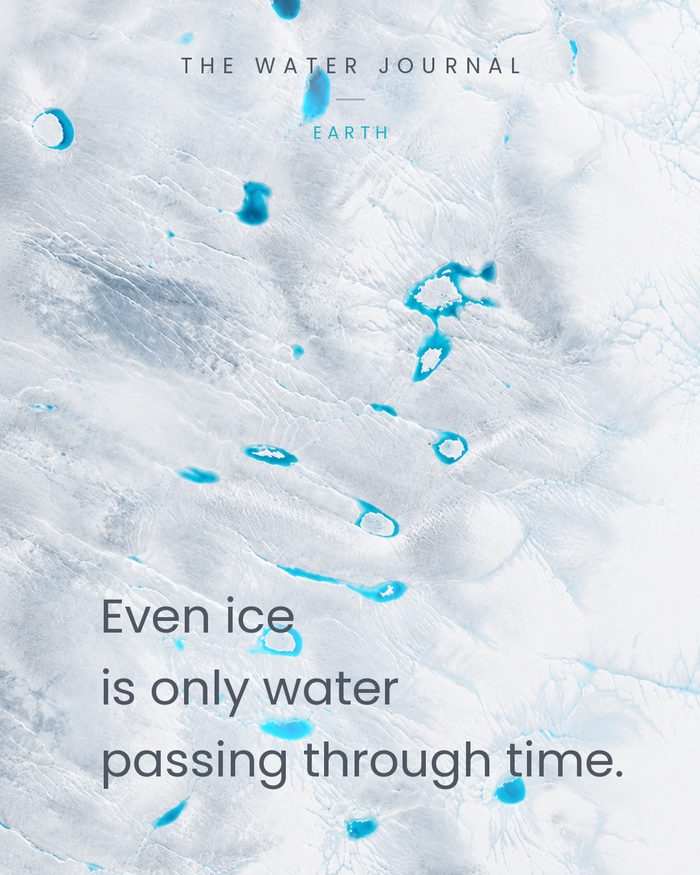
That interval is a property of the place, not of the water. Move the same molecules a few hundred kilometres towards the coast and the pause shortens from a million years to a few thousand. Warm the surface enough and it collapses to a season. The melt ponds on the cover of this issue are that shortening, photographed in progress — surface water on an ice sheet, briefly liquid again, having waited a long time for the opportunity.
Which is also the quiet argument for drilling now. The archive is not stored in a vault. It is stored in the thing it is a record of, under conditions that the record itself says are unusual, and where those conditions relax, the pause ends and the information goes with it.
A layer of ice can remain frozen for more than a million years. The remarkable part is not that the H₂O survives. It is that traces of the atmosphere and the climate in which it formed survive with it.
Sources and notes
01 — The continuous record
Beyond EPICA – Oldest Ice, press releases via the Alfred Wegener Institute, the British Antarctic Survey and CNR-ISP, January and November 2025. — 2,800 m core to bedrock at Little Dome C; chemical analysis of 190 m from the deep section completed in late 2025, confirming a complete record back at least 1.2 million years, the oldest continuous ice-core record yet retrieved; the record may extend beyond 1.2 million years as dating of the deepest usable ice continues; lowest 210 m heavily deformed, possibly mixed or refrozen, of unknown origin; site 35 km from Concordia Station, 3,200 m above sea level, mean summer temperature about −35 °C; four field seasons and more than 200 drilling and processing days.
EPICA Community Members, "Eight glacial cycles from an Antarctic ice core," Nature, vol. 429 (2004), pp. 623–628. — the previous continuous record, reaching about 800,000 years.
02 — The discontinuous record
S. Shackleton et al., "Miocene and Pliocene ice and air from the Allan Hills blue ice area, East Antarctica," PNAS, vol. 122, no. 44 (2025), e2502681122. — ice up to about 6 million years old, dated by ⁴⁰Ar deficit; shallow cores of 100–200 m; stratigraphically complex; approximately 12 ± 2 °C of cooling in East Antarctica over 6 Myr; basal ice nearly devoid of gases and as yet undated.
Y. Yan et al., "Two-million-year-old snapshots of atmospheric gases from Antarctic ice," Nature, vol. 574 (2019). — the previous record for directly dated ice, at least 2.7 million years, also from the Allan Hills.
Note on evidence
The 1.2-million-year figure is a minimum: the record has been confirmed to reach at least that far, and the deepest usable ice may prove older as dating work continues. The lowest 210 metres above the bedrock are excluded from it.
The Allan Hills ice is not a continuous record. Its layers are disturbed, so the material provides dated snapshots of ice and air rather than a sequence, and the cooling figures quoted are inferred from water isotopes across those snapshots.
Residence times given for the atmosphere, rivers and lakes are conventional averages and vary widely between individual systems.
Cover image: melt ponds on an ice surface. It illustrates the shortening of the pause described in the closing section and is not an image of the drilling sites discussed here.