Seven Point Four
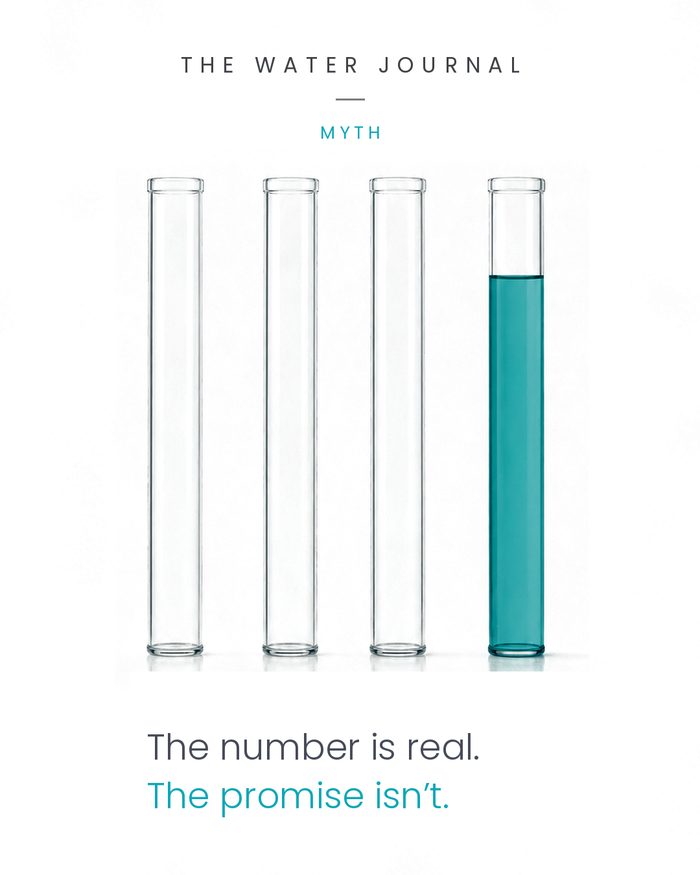
Bottled water is sold on the promise that it will shift the pH of the body. The body's pH is one of the most tightly defended numbers in human physiology. Both things are true, which is what makes this myth worth taking apart carefully.
What the claim actually says
The pitch is now standard on shelves and labels: water at pH 8.5 or 9.5, sold as alkaline, ionised or high-pH, with the implication that ordinary water leaves you acidic and this water corrects it. Sometimes the claim is explicit — that modern diets acidify the blood, and that drinking alkaline water restores it. Sometimes it is left as an atmosphere.
It is worth stating what the claim requires in order to be true. It requires that an ordinary bottle of high-pH water can meaningfully reset systemic pH — and that doing so would improve health. Neither half survives contact with the physiology.
This is not a case where the science is unsettled and the marketing is early. The regulation of blood pH is one of the best-characterised control systems in the body, and it was described in detail long before anyone tried to sell water on it.
Myth
Alkaline water balances your body's pH.
Reality
Arterial blood pH is normally maintained close to 7.4 by buffers, lungs and kidneys. Ordinary high-pH water does not reset it. Large enough alkali loads can shift bicarbonate and pH temporarily — which is why dose matters.
pH is not a dose
A pH number on its own says almost nothing about how much acid a water can neutralise. At pH 9, a litre holds only about ten micromoles of free hydroxide. Bicarbonate and other dissolved buffers can add far more alkalinity than that, and their concentration varies enormously between waters — from almost nothing to grams per litre in the bicarbonate-rich mineral springs.
That distinction matters, because high pH and high buffering capacity are not the same thing. Anything drunk arrives first in a compartment built to be acidic: gastric contents typically sit around pH 1.5 to 3.5, well within the acidic range in which pepsin, the stomach's protein-splitting enzyme, is active. A small alkaline challenge is neutralised there quickly. A bicarbonate-rich water carries a chemically meaningful buffer load. Neither fact means that a bottle balances the body.
The body defends the number
Downstream of the stomach, the defence is layered. Blood carries a bicarbonate buffer that absorbs added acid or base chemically, within seconds. Ventilation adjusts within minutes: breathing off carbon dioxide removes acid, and slowing ventilation retains it. The kidneys work over hours and days, reabsorbing filtered bicarbonate, generating new bicarbonate, and excreting net acid as ammonium and titratable acid.
The result is a plasma pH normally held between 7.35 and 7.45 — a span of one tenth of a pH unit, defended against a metabolism that generates acid all day. A blood pH below the normal range is acidemia; above it, alkalemia. Acidosis and alkalosis are the processes driving those changes. These are clinical acid–base states and processes, not lifestyle conditions: they arrive with kidney failure, uncontrolled diabetes, severe vomiting, respiratory disease. They do not arrive with dinner.
The system also has enormous spare capacity in the direction the marketing points. The kidney can multiply its excretion of ammonium several-fold when an acid load appears. A body that could be pushed out of range by a bottle of water would not survive a normal week.
Why urine fooled everyone
There is one measurement that does move — and it makes the belief look remarkably convincing. Urine pH shifts with diet, and it shifts noticeably: a meal heavy in protein and grain lowers it, a meal heavy in fruit and vegetables raises it. Test strips are cheap, the effect is real, and the interpretation is backwards.
Urine is where the kidney puts what it has decided to remove. A more acidic urine is not evidence that the body has become acidic; it is evidence that the body has just protected its pH by exporting acid. The strip is reading the exhaust, not the engine.
Urine is the body's receipt. It is not its verdict.
Where the idea came from
The alkaline claim has a respectable ancestor. Early twentieth-century nutrition described foods by the residue they leave after combustion — the acid-ash hypothesis — and proposed that an acid-forming diet forces the body to draw calcium from bone in order to neutralise it. It was a reasonable hypothesis, and it was tested.
A 2009 meta-analysis of calcium-balance studies found that the acid-ash effect on calcium retention did not hold up, and a 2011 systematic review applying formal criteria for causation concluded that the evidence did not support dietary acid load as a cause of bone disease. That version of the hypothesis — dietary acid load as a cause of osteoporosis — did not survive its own literature.
The cancer version travelled further and rests on a real observation used wrongly. Tumour microenvironments are frequently acidic — but that acidity is produced locally by tumour metabolism, inside tissue whose systemic pH remains normal. A 2016 systematic review searching for evidence that dietary acid load or alkaline water affects the development or treatment of cancer found one eligible study, no randomised trials, and no support for the claim. Its authors concluded that promoting alkaline diets or alkaline water for cancer is not justified.
What alkaline water does do
Refusing the systemic claim is not the same as saying the water is inert. There is a narrow, documented effect, and it is local rather than systemic.
Pepsin needs acid. In laboratory work published in 2012, alkaline drinking water at pH 8.8 irreversibly inactivated human pepsin in vitro, while ordinary water at pH 6.7 to 7.4 did not, and the alkaline water buffered hydrochloric acid better than the conventional bottled waters tested. For reflux that reaches the throat, where pepsin deposited in tissue can be reactivated by any later acid, that is a plausible mechanism for symptom relief — and it says nothing whatsoever about blood.
Clinical evidence has since moved beyond mechanism alone. In 2023 a multicentre, double-blind, randomised, placebo-controlled trial in 148 adults with frequent heartburn compared 1.5 litres a day of a bicarbonate-rich mineral water against a conventional mineral water over six weeks. Response rates were 84.7% against 63.5%, with a number needed to treat of five. The trial tested one specific high-bicarbonate water rather than alkaline water as a category, and it was industry-supported — but it is controlled evidence for a local gastrointestinal effect. A weaker, retrospective study from 2017 pointed the same way for reflux reaching the throat, using alkaline water combined with a plant-based Mediterranean diet, where diet and water cannot be separated in the result.
The contrast worth keeping is one of dose. Athletes do deliberately shift their blood buffering before hard exercise, and it works — by swallowing sodium bicarbonate at something like 0.2 to 0.3 grams per kilogram of body mass. For a 70-kilogram athlete that is roughly 14 to 21 grams: a deliberate alkali dose, with gastrointestinal consequences to match, rather than a pH number on a label. Physiology can be nudged. It takes a dose, not a label.
What to look for instead
If pH is the wrong thing to read on a label, something else is worth reading. The mineral analysis printed on a bottle of mineral water — calcium, magnesium, bicarbonate, sodium, sulphate, total dissolved solids — describes what the water will taste like and what it contributes to a diet. Those numbers vary enormously between sources, and they are the honest difference between one water and another.
Nor is high pH a guarantee of quality in itself. In 2020 investigators in Nevada and California linked a cluster of acute non-viral hepatitis to consumption of one brand of alkaline bottled water. The causative agent was never identified. The lesson is not that alkaline water is dangerous. It is that the word on the front of a bottle tells you almost nothing about its full composition — or whether it is safe.
The myth is durable because it offers something physiology does not: a dial. A body with a dial on it could be tuned by shopping. What the acid–base system actually offers is stability so reliable that it is invisible — lungs and kidneys holding one number inside a tenth of a unit, every hour of a life, without being asked.
The pH of the water in front of you is a genuine property of that water. It does not become a new setting for your body when you swallow it.
Sources and notes
01 — The physiology
L. L. Hamm, N. Nakhoul and K. S. Hering-Smith, "Acid-Base Homeostasis," Clinical Journal of the American Society of Nephrology, vol. 10, no. 12 (2015), pp. 2232–2242. — buffering, respiratory and renal control of plasma pH; renal net acid excretion as titratable acid and ammonium.
S. Quattrini, B. Pampaloni and M. L. Brandi, "Natural mineral waters: chemical characteristics and health effects," Clinical Cases in Mineral and Bone Metabolism, vol. 13, no. 3 (2016), pp. 173–180. — mineral and bicarbonate content across natural waters.
A. C. Guyton and J. E. Hall, Textbook of Medical Physiology, 14th ed. (Elsevier, 2020). — normal arterial pH 7.35–7.45; gastric acid secretion and gastric pH; physiological regulation of acid–base disturbances.
02 — The claims tested
T. R. Fenton, A. W. Lyon, M. Eliasziw, S. C. Tough and D. A. Hanley, "Meta-analysis of the effect of the acid-ash hypothesis of osteoporosis on calcium balance," Journal of Bone and Mineral Research, vol. 24, no. 11 (2009), pp. 1835–1840.
T. R. Fenton, S. C. Tough, A. W. Lyon, M. Eliasziw and D. A. Hanley, "Causal assessment of dietary acid load and bone disease," Nutrition Journal, vol. 10 (2011), art. 41. — Hill's criteria applied; evidence does not support causation.
T. R. Fenton and T. Huang, "Systematic review of the association between dietary acid load, alkaline water and cancer," BMJ Open, vol. 6, no. 6 (2016), e010438. — 8,278 citations screened, one eligible study, no randomised trials; promotion of alkaline diet or alkaline water for cancer judged unjustified.
03 — The narrow effect
J. A. Koufman and N. Johnston, "Potential benefits of pH 8.8 alkaline drinking water as an adjunct in the treatment of reflux disease," Annals of Otology, Rhinology & Laryngology, vol. 121, no. 7 (2012), pp. 431–434. — in vitro; irreversible inactivation of human pepsin at pH 8.8 and acid-buffering capacity above that of conventional bottled waters.
J. Labenz, M. Anschütz, J. Walstab, R. S. Wedemeyer, H. Wolters and B. Schug, "Heartburn relief with bicarbonate-rich mineral water: results of the randomised, placebo-controlled phase-III trial STOMACH STILL," BMJ Open Gastroenterology, vol. 10 (2023), e001048. — 148 adults, 1.5 L/day for six weeks; responder rates 84.72% against 63.51% (p = 0.0035), number needed to treat 5.
C. H. Zalvan et al., "A comparison of alkaline water and Mediterranean diet vs proton pump inhibition for treatment of laryngopharyngeal reflux," JAMA Otolaryngology — Head & Neck Surgery, vol. 143, no. 10 (2017), pp. 1023–1029. — retrospective; diet and water not separable.
R. J. Maughan et al., "IOC consensus statement: dietary supplements and the high-performance athlete," British Journal of Sports Medicine, vol. 52, no. 7 (2018), pp. 439–455. — sodium bicarbonate as a buffering agent and the doses at which it acts.
J. C. Ruff et al., "Notes from the Field: Acute Nonviral Hepatitis Linked to a Brand of Alkaline Bottled Water — Clark County, Nevada and California, 2020," MMWR, vol. 70, no. 46 (2021), pp. 1617–1619.
Note on evidence
Koufman and Johnston 2012 is an in vitro study. It demonstrates what pH 8.8 water does to pepsin in a laboratory vessel, not what drinking it does to a patient, and it makes no claim about systemic pH.
The 2023 STOMACH STILL trial was conducted with a single named bicarbonate-rich mineral water and was supported by its producer. Its result supports a local gastrointestinal effect for that water at 1.5 litres a day; it is not evidence for high-pH water as a category, and it reports nothing about systemic pH.
Zalvan et al. 2017 is retrospective and compares a combined intervention — alkaline water plus a plant-based Mediterranean diet — against medication. It cannot attribute its result to the water.
Fenton and Huang 2016 found an absence of evidence rather than evidence of absence: almost no research exists on alkaline water and cancer. The authors' conclusion is that promotion of the claim is unjustified, which is not the same as a demonstrated null effect.
The figure of ten micromoles of hydroxide per litre is the arithmetic of pH 9 in pure water. Commercial alkaline waters carry additional neutralising capacity as dissolved bicarbonate and minerals, which is why buffering capacity, not pH, is the quantity Koufman and Johnston measured.
Blood pH values here are arterial. Venous, intracellular and urinary pH differ, and conflating them is a recurring source of confusion in this subject.
The 2021 MMWR report describes an outbreak associated with one brand. It is cited as a caution about labels, not as a property of alkaline water in general.
Nothing here is medical advice, and none of it is about any individual's condition. Reflux and acid–base disorders are clinical matters for a clinician.