Judgement Goes First
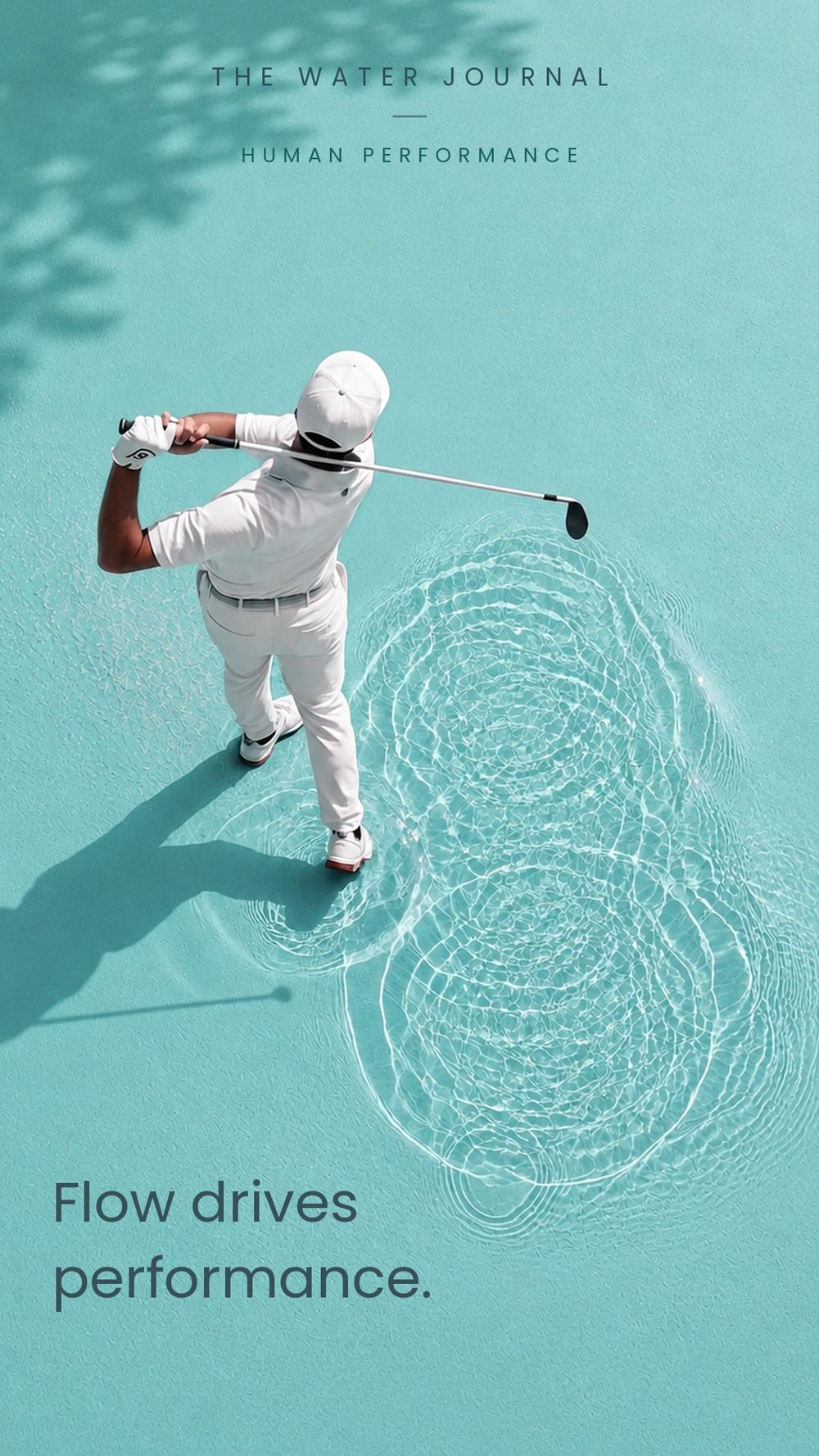
Golf looks calm. It isn't. Every shot is a measurement made under pressure — and in one small controlled study, the measure that changed most proportionally was not shot distance. It was the reading of the shot.
The shot is a calculation
Stand behind the ball and the work begins before anything moves. How far is the flag. How much of that is carry and how much is run. What the wind is doing at head height and what it is doing forty metres up. Whether the ground tilts under the stance. What the lie will take off the strike.
Only then does the body do what it has been trained to do. The swing is the execution. The measurement comes first, and it is the harder half. That is the sense in which judgement goes first — it opens the shot. Nothing below is a claim about which faculty fails soonest when water runs short.
That measurement runs on water. Not as a metaphor — as a working condition.
What was measured
In 2012 a team at the University of Lincoln put the question to a controlled test. Seven low-handicap players — average handicap 3 — completed the same golf-specific task twice, a week apart, in randomised order. Once normally hydrated. Once after twelve hours without fluid, which left them about 1.5% below their own baseline body mass. A deficit small enough to be easy to miss, and produced without a single minute of extra exertion.
Three measures moved. Shot distance fell from 128 to 114 metres. Lateral error — how far off line the ball finished — rose from 4.1 to 7.9 metres. And the players' own estimate of how far away the target was went from 4.1 metres of error to 8.8.
Same players. Same task. Same skill, trained over years. The only variable was water.
The asymmetry
Read the three figures together and they are not the same size. Shot distance fell by about 11%. Lateral error nearly doubled. Distance-judgment error more than doubled.
The study's own classification is worth keeping straight. Shot distance and lateral accuracy are motor outcomes; the estimate of range is the cognitive one. And the experiment compared two states — hydrated and dehydrated — rather than tracking a deficit as it deepened. Nothing in it establishes an order of failure. What it records is which measure had changed most proportionally by the time body-mass loss reached 1.5%: the one made before the club moves.
That is not the result most people expect. A water deficit is usually imagined primarily as a physical brake. In this experiment, shot distance did fall by fourteen metres — although the study did not establish the physiological mechanism behind that change. What it does show is that the largest proportional change belonged to the part of the task that happens while the club is still on the ground.
Where this sits in the evidence
Judging a distance is not one faculty but three working together: holding attention on the target, running the comparison against everything already known about the club and the conditions, and translating the answer into a movement. Attention, executive function, motor coordination.
Those are the domains the wider literature keeps returning to — and the wider literature is less tidy than one experiment. A 2018 meta-analysis pooling 33 studies and 413 subjects found a small but significant overall effect of a water deficit on cognitive performance, concentrated in attention, executive function and motor coordination, and clearest once losses passed roughly 2% of body mass. A 2019 meta-analysis, restricted to hypohydration produced actively through exercise or heat, found no significant overall impairment at all.
Golf-specific evidence is mixed. In a 2017 observational study, golfers who began a competitive 18-hole round classified as dehydrated took more strokes than their euhydrated counterparts, although the design could not establish causation. A 2019 randomised crossover pilot in six elite female golfers then found no significant differences between hydration conditions, despite some non-significant trends in the same direction.
The Lincoln players were 1.5% down, below the threshold where the 2018 pooling finds its strongest effects, and there were seven of them. That makes the result striking rather than settled: one small, sport-specific experiment, run in a task built almost entirely out of the faculties the argument turns on.
Precision is not only trained. It is maintained.
Thirst is a signal, not a gauge
The practical difficulty is that thirst reports a state without measuring it. Rising plasma osmolality is a major homeostatic driver, but volume signals feed in as well, and the response begins to change before swallowed water has reached the blood at all. Thirst can signal a need to drink. It does not quantify the size of a body-water deficit, or what that deficit is costing the next approach shot.
The Lincoln players had not run a marathon. They had simply undergone a twelve-hour overnight fluid restriction — enough, in this small sample, to produce a measurable 1.5% deficit. Nothing dramatic happened. Their reading of distance simply became less accurate.
What it means on the course
The useful conclusion is not that water makes anyone a better player. It is that a trained skill has a maintenance condition, and that this particular condition is invisible from the inside.
Over a long round, heat, sweat and imperfect fluid intake can all change hydration status. Exactly how much that changes golf performance will vary by player and by conditions — which is why hydration is better treated as a variable to manage than an advantage to chase.
The lesson is not to outrun thirst with unlimited water. Drinking far beyond losses over prolonged exercise carries its own risk — exercise-associated hyponatraemia among them — and the 2015 consensus specifically warns against overdrinking and supports thirst-guided intake. The lesson is to arrive with a plan matched to the player, the weather and the length of the round, instead of leaving the variable to be discovered on the seventh green.
Golf looks calm. What it actually is, is a long sequence of measurements — and every one of them is taken by an instrument that runs on water.
Sources and notes
01 — The golf evidence
M. F. Smith, A. J. Newell and M. R. Baker, "Effect of Acute Mild Dehydration on Cognitive-Motor Performance in Golf," Journal of Strength and Conditioning Research, vol. 26, no. 11 (2012), pp. 3075–3080. — randomised counterbalanced crossover, seven-day washout; n = 7, mean handicap 3; 1.5 ± 0.5% body-mass loss. The authors classify shot distance and lateral accuracy as motor performance and distance judgment as cognitive performance. A single small study; the effect sizes have not been reproduced at this magnitude.
P. J. Magee, A. M. Gallagher and J. M. McCormack, "High Prevalence of Dehydration and Inadequate Nutritional Knowledge Among University and Club Level Athletes," International Journal of Sport Nutrition and Exercise Metabolism, vol. 27, no. 2 (2017), pp. 158–168. — observational; golfers beginning a competitive 18-hole round dehydrated by urine specific gravity took 79.5 ± 2.1 strokes against 75.7 ± 3.9 for euhydrated players (p = .049). Cross-sectional design; no causal inference.
W. Stevenson, J. S. Zabinsky and V. E. Hedrick, "Effects of Dehydration on Cognitive and Physical Performance in Female Golfers: A Randomized Crossover Pilot Study," J, vol. 2, no. 4 (2019), pp. 496–507. — pilot randomised crossover, n = 6 elite female golfers, 12-hour overnight fluid fast; no significant differences between hydration conditions, with non-significant trends in the same direction as Smith et al.
02 — The wider literature
M. T. Wittbrodt and M. Millard-Stafford, "Dehydration Impairs Cognitive Performance: A Meta-analysis," Medicine & Science in Sports & Exercise, vol. 50, no. 11 (2018), pp. 2360–2368. — 33 studies, 413 subjects, 280 effect estimates; pooled effect size −0.21 (95% CI −0.31 to −0.11), concentrated in attention, executive function and motor coordination, and most evident beyond approximately 2% body-mass loss.
S. P. J. Goodman, A. T. Moreland and F. E. Marino, "The effect of active hypohydration on cognitive function: A systematic review and meta-analysis," Physiology & Behavior, vol. 204 (2019), pp. 297–308. — pooled effect g = −0.177 (95% CI −0.532 to 0.179; p = .331); no significant impairment overall or within the cognitive domains examined.
03 — Guidance and mechanism
T. Hew-Butler et al., "Statement of the Third International Exercise-Associated Hyponatremia Consensus Development Conference, Carlsbad, California, 2015," Clinical Journal of Sport Medicine, vol. 25, no. 4 (2015), pp. 303–320. — warns against drinking in excess of losses and supports thirst-guided intake.
C. A. Zimmerman, Y.-C. Lin, D. E. Leib, L. Guo, E. L. Huey, G. E. Daly, Y. Chen and Z. A. Knight, "Thirst neurons anticipate the homeostatic consequences of eating and drinking," Nature, vol. 537, no. 7622 (2016), pp. 680–684. — animal model (mouse); thirst-promoting neurons integrate blood composition with rapid oral signals, adjusting the response before consumed fluid reaches the blood.